Marine planned maintenance software has replaced paper logbooks and reactive servicing on most offshore support vessels, workboats and tugs. A planned maintenance system (PMS) schedules servicing, tracks spare parts and keeps records ready for audits, but it is only as reliable as the data it receives. If engine hours and equipment readings are out of date, the maintenance schedule is too.
Before choosing or upgrading marine planned maintenance software, it is worth checking five things: where the data comes from, whether it supports condition based maintenance, how it connects to onboard systems, how it works across a fleet and how it handles audits.
The most common failure point of any planned maintenance system is reliance on manual data entry. If a crew member, such as an engineer, is required to manually read engine running hours from a dial and type them into the PMS at the end of a shift, the system is vulnerable to human error, delayed inputs, and administrative fatigue.
For an effective system to be utilised, it is best that data input is automated in real-time. By deploying telemetry hardware on board, exact engine running hours, fuel flow, and system loads are extracted from the engine ECUs (Electronic Control Units). This live data feeds continuously into the PMS, ensuring maintenance schedules are accurate and based on real information, with a far lower likelihood of error.
Traditional maintenance strategies operate on arbitrary calendar dates (for example, servicing an alternator every six months) or basic running-hour limits. This can result in over-servicing healthy machinery and thus causing unnecessary expenditure, or missing early-stage failures that occur between scheduled dates (resulting in another unnecessary expenditure).
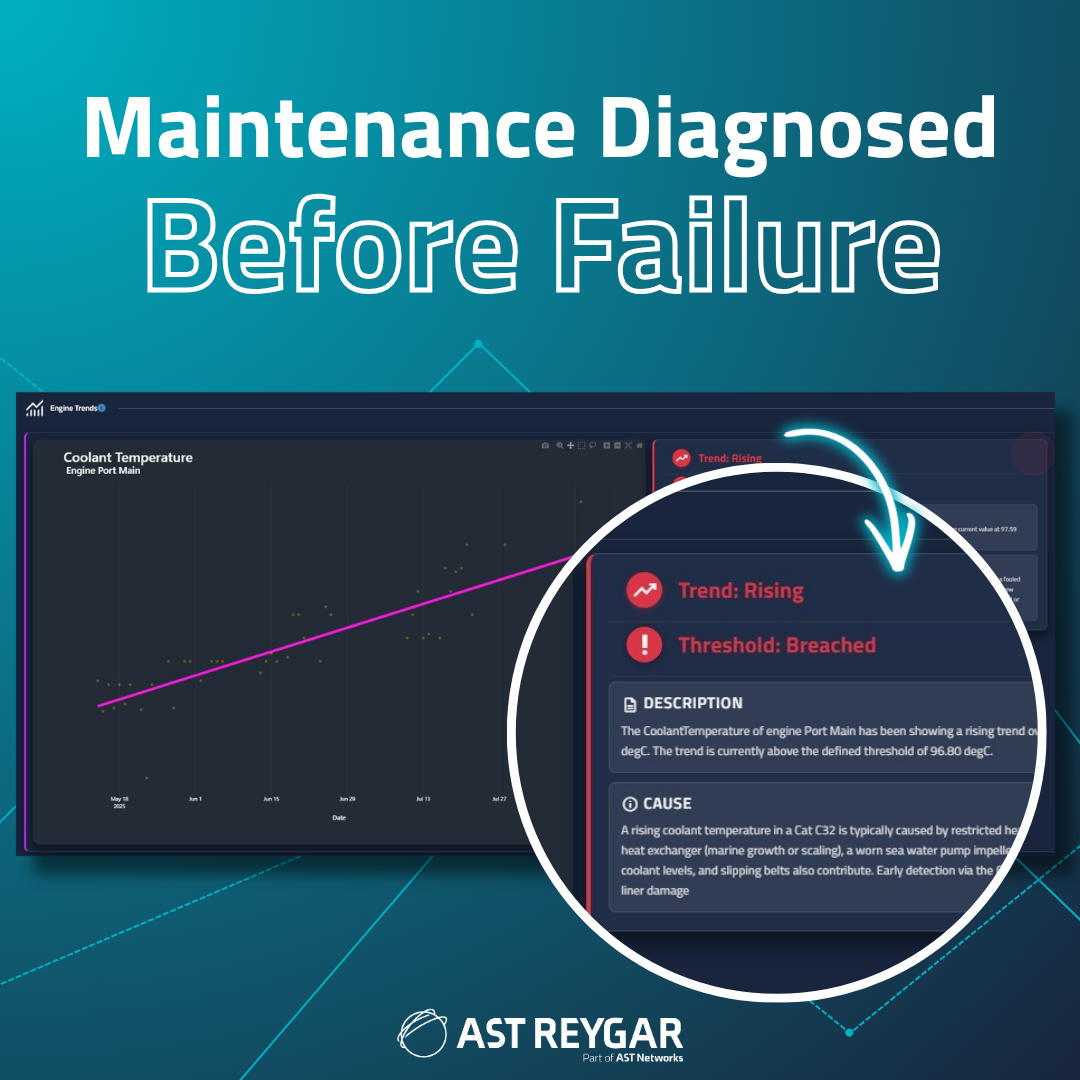
A future-proof planned maintenance system should facilitate condition-based maintenance. Our BareFLEET system continuously monitors high-fidelity parameters (such as exhaust gas temperatures, oil pressures, and coolant efficiency). If a parameter deviates from its baseline, BareFLEET identifies the predictive anomaly and which triggers an alert, prompting the creation of a targeted work order in the PMS before a mechanical failure occurs.
Maintenance software cannot exist in a silo. When evaluating a planned maintenance system, you must consider its API (Application Programming Interface) architecture and its ability to communicate with your selected vessel telemetry platform.
AST Reygar has engineered BareFLEET to integrate seamlessly with the maritime industry’s leading Planned Maintenance Systems, including Helm CONNECT, Crewsmart, and Marad. This ensures that alarms, runtime thresholds, and critical engine health metrics are automated, integrated and fed into your existing maintenance workflows.
Standardisation is critical when it comes to large and varied fleets. A well-integrated PMS ensures that a routine 10,000-hour major overhaul is executed with the exact same procedure, parts list, and safety checks on a vessel in the North Sea as it is on a sister vessel operating in the Americas.
By unifying cross-fleet telemetry tracking with a robust PMS, shore-side managers establish verified facts to support effective decision making. You can compare the mechanical degradation rates of sister vessels side-by-side, allowing you to refine your corporate maintenance strategies based on objective fleet-wide intelligence rather than anecdotal crew feedback.
Maritime compliance is incredibly stringent. When surveyors or charter clients audit a vessel, they expect immediate and transparent proof of maintenance history, defect resolution, and structural safety.
Using a Planned Maintenance System generates a flawless, unalterable digital audit trail. Because the system is fed by automated BareFLEET telemetry rather than human estimates, superintendents can confidently present verified records of engine hours, resolved alarms, and completed work orders, drastically reducing the administrative burden of class surveys.
To understand how telemetry elevates a Planned Maintenance System, consider the automated flow of data from the engine room to the final work order.
A properly implemented Planned Maintenance System is a powerful tool for maritime fleets, provided it is fueled by accurate, automated intelligence. By integrating AST Reygar’s BareFLEET platform with your chosen PMS, you eliminate administrative delays, shift to predictive, condition-based servicing, and ultimately ensure your vessels remain operational and on charter.
Ready to bridge the gap between your engine room and your maintenance software? Contact the AST Reygar engineering team today to learn how BareFLEET seamlessly integrates with industry-leading planned maintenance systems.
It is software that schedules and records maintenance on a vessel’s engines, machinery and equipment. Tasks can be triggered by calendar dates, running hours or measured equipment condition, and the software keeps the service history needed for class surveys and audits.
Condition based maintenance means servicing equipment when its measured condition shows it is needed, such as rising temperatures, vibration or fuel use, instead of at fixed intervals. It relies on live data from the vessel, which a monitoring system such as BareFLEET provides.
Yes, when it is connected to a monitoring system. BareFLEET records engine running hours automatically and can pass them to your planned maintenance system, so the schedule stays up to date without manual entry.
BareFLEET works alongside the planned maintenance software you already use. It supplies the live engine and equipment data, and your PMS handles the scheduling, parts and records.
Want to see how BareFLEET could work for your fleet? Contact the AST Reygar team to arrange a demo.
Ask an expert
Whether you are looking at fuel monitoring, maintenance, vessel performance or remote asset monitoring, our team will give you a straight answer. We usually reply within one working day.

