A service operation vessel (SOV) is a large offshore support ship that stays at a wind farm for weeks, housing maintenance technicians on board and walking them onto turbines over a motion-compensated gangway. This guide is for SOV operators, charterers and wind farm owners. It covers where an SOV's fuel goes, how to get more transfers from each weather window, how to keep technicians fit over a long rotation, and the emissions reporting now coming into force.
An SOV is a mothership for offshore wind maintenance. It holds position on dynamic positioning (DP), transfers crews by gangway or daughter craft, and carries the spare parts and workshops needed for a full rotation. Technicians typically rotate every two weeks, with the vessel returning to port for about a day to change crews, load cargo and refuel (TNO).
| Crew transfer vessel (CTV) | Service operation vessel (SOV) | |
|---|---|---|
| Time offshore | Day trips from port | Stays on site, crews rotate about every two weeks |
| Technicians | 12 to 24 | Up to around 75 |
| Transfer method | Bow pushed against the turbine boat landing | Motion-compensated gangway |
| Transfer wave limit | About 1 to 2.2 m significant wave height, depending on hull | 3.5 m or more, depending on gangway |
| Best suited to | Wind farms within about 70 km of port | Wind farms further offshore |
| Day rate | Lower | Roughly 8 to 10 times a CTV |
With a day rate around eight to ten times that of a CTV, every hour of an SOV's rotation needs to count. The sections below look at where that time and money goes.
An SOV spends its rotation in three broad modes: transit to and from port, holding position on DP next to a turbine, and standing by while teams work. Each burns fuel very differently, and a single daily fuel figure hides which mode is costing the most.
DP is often the least visible cost. To meet redundancy requirements, a DP vessel may run more generators than the load needs, leaving each one working at low, inefficient load. Research from TU Delft on a DP vessel found that better generator load allocation alone could cut fuel use by up to 5.5% with an open bus-tie and 11.3% with a closed bus-tie.
Operators who measure fuel by mode can act on questions like these:
BareFLEET measures fuel consumption in real time against speed and engine load, so each operating mode can be separated and compared across a rotation. AST Reygar reports that BareFLEET customers cut fuel costs by up to 20%.
Walk-to-work gangways let SOVs transfer technicians in far rougher seas than a CTV. Ampelmann's SOV system is rated to a significant wave height of 3.5 metres (Riviera), and longer gangways are rated higher still. Even so, transfer time is tight. Rolls-Royce describes an SOV serving six to eight maintenance teams per shift with about 20 minutes for each drop-off or collection.
Recording sea state, vessel motion and timing for every transfer shows where the day is being lost: slow approaches, weather calls that could have gone the other way, or turbines visited in an inefficient order. Over a season, that record also gives operators and wind farm owners firmer evidence for go or no-go decisions.
Technicians live on an SOV for weeks, so vessel motion affects their sleep, comfort and readiness to work, as well as the transfer itself. Even a well-designed vessel can roll in a beam sea, and the effects build up over a rotation.
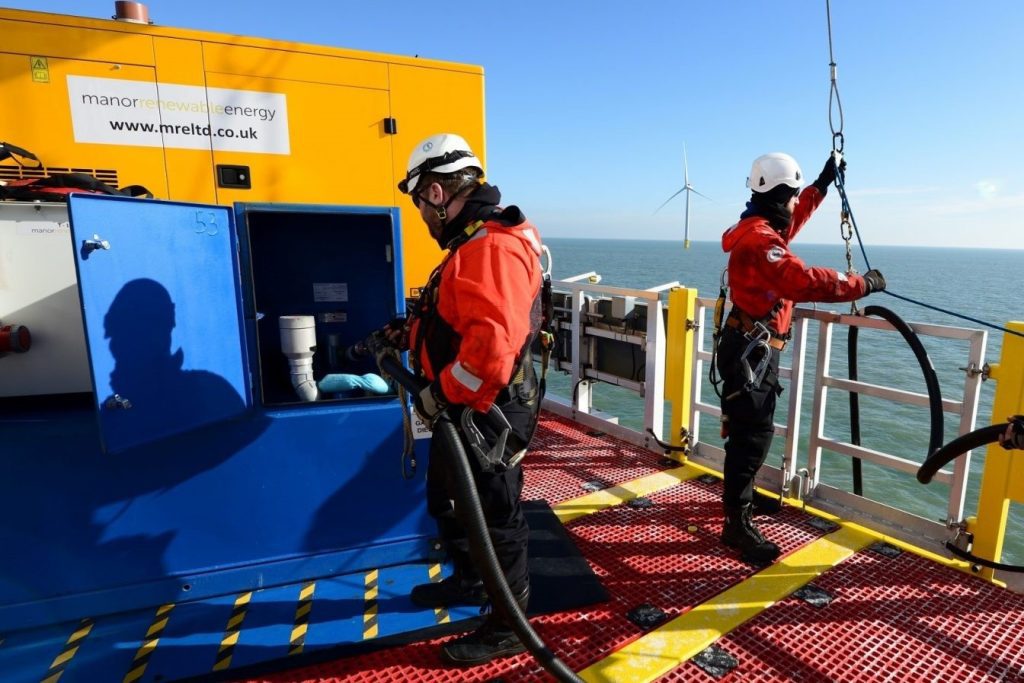
BareFLEET's vessel motion monitoring calculates a Motion Sickness Index in line with ISO standards and measures whole body vibration in cabins. With that data, crews can compare headings on DP, plan routes and cabin allocations around motion, and show charterers how welfare is being managed.
Charterers and wind farm owners increasingly ask for vessel emissions data as part of their own decarbonisation targets, and regulation is following. Under the EU MRV regulation, offshore ships over 400 GT have had to monitor and report emissions since 1 January 2025, and offshore ships over 5,000 GT join the EU Emissions Trading System from 1 January 2027 (Hellenic Shipping News). Larger SOVs and CSOVs can sit above that threshold, so operators should check each vessel's tonnage now.
BareFLEET tracks CO₂, NOx and SOx emissions from measured fuel use, with a fleet-wide decarbonisation dashboard for reporting to clients and regulators.
An SOV only returns to port briefly between rotations, so machinery problems need to be caught early. Engine alarms, warning thresholds and trend analysis flag developing issues at sea, and running hours feed straight into planned maintenance systems, so servicing follows how hard each engine has actually worked.
For operators adding monitoring to one vessel or a whole fleet, this order usually gives the quickest return:
Find out more about SOV monitoring with BareFLEET, or see how it is used on crew transfer vessels.
SOV stands for service operation vessel, a ship that stays at an offshore wind farm and houses maintenance technicians on board.
A walk-to-work vessel has a motion-compensated gangway, so technicians can walk directly onto a turbine or platform. Most SOVs and CSOVs are walk-to-work vessels.
A commissioning service operation vessel (CSOV) is built to support construction and commissioning as well as maintenance, so it usually carries more people and more cargo-handling equipment, such as a 3D motion-compensated crane.
Dynamic positioning uses thrusters to hold the ship in place, and redundancy rules often mean several generators run at low load. Measuring fuel by operating mode shows how much of a rotation's fuel goes on DP.
Yes. BareFLEET is used on CTVs and SOVs, so operators can compare fuel, emissions and motion data across a mixed fleet in one platform. Contact AST Reygar to discuss your vessels.
SOV crews rely on fast internet and reliable communications for weeks at a time. AST Networks, our sister company, provides satellite connectivity for offshore vessels.
Ask an expert
Whether you are looking at fuel monitoring, maintenance, vessel performance or remote asset monitoring, our team will give you a straight answer. We usually reply within one working day.

